
Guide
Manual
How to get the collar working, and what the map is actually telling you. Written to be read once, the evening before you first take it out. If you only need one thing, jump straight to it.
01
What you need
Three things. That is the whole list.
- The collar with the tracker — IK122T or IK122T Pro.
- A SIM card that goes into the collar. Any carrier, the cheapest plan they sell. The collar sends tiny packets, it is not streaming video. But two things must be right, or the collar will never report: the card needs mobile data (calls and SMS alone are not enough) and the PIN must be disabled. The collar has no keypad to enter one. Turn the PIN off by putting the card in a phone first (Settings → Security → SIM lock), then move it to the collar.
- An Android phone with the DogTracker app. There is no iPhone version, and we are not going to pretend otherwise.
The collar does not talk to your phone directly. It reports its position over its own SIM to our server, and the app reads it from there. So both of you need signal — if you are the one standing in a dead spot, your map sits still until you climb out of it.
02
Setting up and pairing the collar
Do this at home, unhurried, the day before you go out. Not at five in the morning in a car park.
- Create an account. Name, email, a password of at least 8 characters. A confirmation link arrives by email — click it right away while you are still at the phone.
- Enter your own phone number as the Admin/SOS number. It is optional, but do it now. It applies to every collar you own, and each new one picks it up on its own as soon as it pairs.
- Test the card in your phone before it goes into the collar. Put it in, open any page to confirm data works, then disable the PIN. Two minutes here save an hour of guessing later — a collar that "will not report" has a locked card or a card without data nine times out of ten.
- Put the SIM card in the collar and switch it on. Leave it outside with a clear view of the sky — indoors it can hunt for satellites for a long while.
- Open Trackers → Add tracker and type in the collar's number. That is the 11-digit number printed on the device itself, not the SIM number.
- Add the number of the SIM card inside the collar too. Not required, but if you fill it in, the next step is one tap instead of copying a number across by hand.
- Send the prepared SMS. The app writes the message for you — you just send it to the SIM number in the collar. Nothing to type, nothing to edit in the text.
- Wait a minute or two. The collar reports to the server and attaches itself to your account — the entry disappears from "Pending requests". There is nothing else for you to do.
- Assign a dog to the collar — name, breed, photo. The photo is not decoration: when three dogs are running across your map, you will pick them apart by face faster than by name.
That SMS is sent once, when you first pair the collar. After that the collar reports on its own, over the internet.
03
Reading the map
The map opens first. It is satellite imagery, so you see the actual woods, clearings and tracks — not just lines. If a plain street map suits you better somewhere, switch the layer.
Tap a dog and you get what the collar is reporting:
- Speed — tells you at a glance whether the dog is working or standing still.
- Heading — which way it is going. Plus the bearing and distance from you to the dog, so you know where to move.
- Collar battery.
- Satellite count — how many the collar has right now. Few satellites means a weaker fix; in thick cover or under a rock face that is normal.
- How old the reading is — "just now", "2 min ago" and so on. Check this one first.
The dot on the map is the last position the collar sent, not where the dog is this second. At rest the collar reports less often, so the dot can be a few minutes old. That is exactly why the age of the reading sits next to every dog.
04
LIVE — when to use it
LIVE means one thing: the collar reports every 5 seconds. The dot moves while you watch it.
Turn it on when the dog is working, when you are trying to catch up to it, when you need to know which side it went round. Leave it off on the walk in, while you are sitting at a stand, and while the dog is lying next to you. Five-second updates buy you nothing there and cost you battery.
LIVE switches itself off:
- after 30 minutes, and
- sooner than that if the collar goes 15 minutes without reporting — it has dropped into a dead spot or shut down.
That shut-off is not a fault, it is battery protection — otherwise the collar would sit at 5-second updates all day and go flat halfway through. Still need it? Turn it back on, one tap.
05
Hunting with a group
When there are five of you and everyone has a dog out, there is no sense in each man watching only his own.
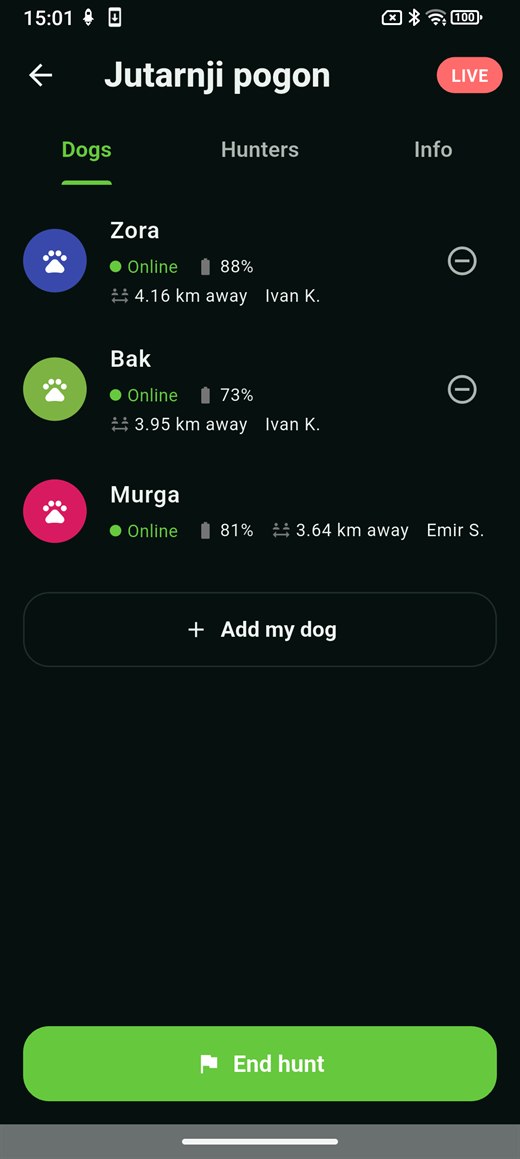
- Open Hunt → New hunt, give it a name and add your dogs.
- Invite the others by email — the address they registered with. Without a DogTracker account there is nowhere for the invitation to land.
- Once they accept, everyone sees every dog in the hunt on one map. Theirs on yours, yours on theirs.
Your own position is never shared automatically. The "Share my location" switch stays off until you turn it on — when you create a hunt, when you accept an invitation, or later in the "Hunters" tab. Turn it off whenever you like. The dogs are always visible; the hunters only if they choose to be.
06
Movement history
The History tab: pick a dog and a day and see where it went. The track can be replayed like a recording, start to finish.
It earns its keep in the evening, once you sit down: where the dog picked up the scent, where it circled, which way it came out, where you lost sight of it. Next time you know where to wait.
Positions are kept for 60 days and deleted in monthly blocks, no later than 92 days after they were recorded — this is not a season archive. If a particular day matters to you, take a screenshot.
07
Collar commands
Commands open from the map — the remote-control button on the right edge. They apply to the dog selected in the header.
- Light — the lamp on the collar comes on. After dark a dog coming out of cover shows up as a moving light long before you hear it.
- Sound — the collar makes a noise. When you know the dog is close but cannot see it, your ears will find it before the map does.
- Training sound — a different tone from the find sound, for dogs trained to respond to it.
- Vibration — a short signal to the dog, for dogs trained to it. Only the IK122T Pro has it. If there is no vibration button in the app, your collar does not have it — nothing is broken.
- Electric impulse — only if your collar supports it. Use it on a dog trained for it; it is not a substitute for training and not a way to force a dog back. The app and the server limit it to 10 impulses per minute and 60 per hour, per collar — beyond that the command is refused. That limit is deliberate and cannot be switched off from the app.
A command does not go straight from your phone to the collar. It travels through the server and the mobile network, so it can take a second or two. If the collar is off the network the commands are greyed out: there is nobody to deliver them to until it reports again.
Device settings — below the commands, on the same screen:
- Location upload interval — how often the collar reports its position when LIVE is off. The default is 30 seconds. Reporting less often means longer battery but an older marker; more often, the other way round. LIVE overrides this temporarily (5 seconds) and restores it when it stops.
- Admin/SOS number — the phone number the collar keeps as its own. You set it, and change it, from the app.
08
Alerts and what they mean
The app tells you four things:
- Collar battery is low. This is the one you really do not want to miss in the middle of a drive.
- The collar went offline, or came back. "Went offline" usually just means the dog crossed into a patch with no coverage — wait for the message saying it is back.
- LIVE was stopped automatically. Either the 30 minutes ran out, or the collar dropped off the network.
- A hunt invitation from someone in your group.
Each one can be switched off on its own in Settings, so keep only what you want. If you have blocked notifications for the whole app in your phone's settings, the app will warn you about it — with them off you will not even hear that the battery is running out.
09
Battery and saving it
We are not going to give you a number of hours, because it honestly depends. On the collar model, on how often it reports, on how much LIVE you used, and most of all on signal: a collar fighting weak coverage all day drains noticeably faster than one sitting on full bars.
What actually helps:
- Leave the resting interval long (every 30 seconds, say). For the walk in, that is more than enough.
- Turn LIVE on when the action starts, not when you leave the house.
- Charge the collar the night before you go, not two days earlier.
- Keep a charger in the car. It has saved many an afternoon.
10
When something goes wrong
I sent the SMS and the collar is not reporting
Give it two or three minutes, then check in order. The first two cover most cases: is the PIN on the card disabled (the collar has no keypad to enter one) and does the card have mobile data, not just calls and SMS. Both take a minute to check by putting the card back in a phone. Only then look at whether the collar is switched on and whether the message actually went to that card's number rather than some other one. If all of that checks out, send the prepared message again — sending it twice does no harm.
The app cannot open my SMS app, or the message will not send
Copy the message text out of the app and send it by hand from your own SMS app to the SIM number in the collar. Do not change the text — not one character. If your carrier rejects it, check that the card you are sending from has credit.
The app will not accept the collar number I typed in
That field wants the 11-digit device number printed on the collar itself — not the SIM number. The SIM number goes in its own separate field, and it is optional.
The dog is not showing up on the map
Look at when the last reading came in. If it says several minutes ago, the collar currently has no network or no clear view of the sky — in a gully, in thick cover or under a rock face that is normal and it sorts itself out as soon as the dog moves into the open. If it has never reported a position at all, take the collar outside and give it time to find satellites.
The position lags or jumps around
Weak satellite reception. The collar reports the best fix it has, so in heavy cover the dot wanders. Once the dog is out in the open the track tidies itself up. The satellite count on the dog's detail screen tells you straight away how good the reception is.
LIVE turned itself off
That is how it is meant to work. It stops after 30 minutes, and sooner if the collar goes 15 minutes without reporting. Turn it back on when you need it.
The command buttons are greyed out
The collar is off the network, so there is nowhere for the command to go. As soon as it reports in, the buttons work again. Only the collar's owner can send commands — people in your hunt can see the dog, but they cannot set off its light or sound.
Someone cannot accept my hunt invitation
Nine times out of ten it is the email address. The invitation goes to exactly the address that person's account was created with — if they registered with a different one, nothing will show up for them. Check the address with them and invite again.
I can see the other dogs but not the other hunters
That is by design. Everyone shares their own position themselves, with the "Share my location" switch — when creating or accepting a hunt, or later in the "Hunters" tab. While that switch is off, nothing is shared. Ask them to turn it on.
History does not go back as far as I want
Positions are kept for 60 days and deleted in monthly blocks, no later than 92 days after they were recorded — which is why a slightly older day can stay visible for a while. Once it has been deleted, that day can no longer be opened.
I forgot my password
Choose "Forgot your password?" on the sign-in screen. A six-digit code arrives by email, it is valid for 15 minutes, and you set a new password with it. If the code does not turn up, check your spam folder.
Support
Stuck?
If something does not behave the way this page says, write to us. Include the collar number and what exactly happened — it gets sorted far quicker than through ten messages back and forth.